Our team is here to support you and solve your power challenges. Connect with our responsive experts today to learn about our customized power solutions and products.
EON Model EL3 (10kW - 55kW) Three Phase
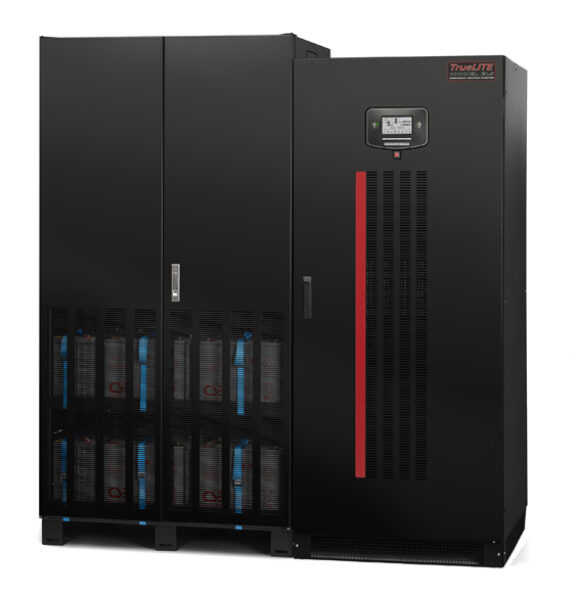
The EON Model EL3 delivers unmatched reliability and performance for large-scale egress lighting systems, with output ratings up to 55kW. Designed to support modern lighting technologies—including LED fixtures with high inrush currents—it ensures seamless, regulated power in both normal and emergency modes, keeping critical spaces illuminated when it matters most.
Engineered for long-term reliability, the EON incorporates advanced DSP-controlled IGBT circuitry and fiber optic communication for fast, noise-free signal processing. This results in precise voltage regulation and dependable performance across all operating conditions. Its compact footprint, one of the smallest in its class, makes it easy to integrate into new or existing facilities without sacrificing valuable floor space.
The EON provides complete design flexibility, powering both “normally on” and “normally off” emergency lighting loads in any combination. It also features programmable transfer delays and remote command options, giving facilities greater control over system operation.
Installation and ownership are made simple with front-access battery cabinets, requiring fewer batteries than many competing systems. This reduces installation time, minimizes space requirements, and lowers long-term maintenance and replacement costs. Automatic testing, logging, and reporting further streamline system management, ensuring compliance and readiness at all times.
Ideal for hospitals, airports, stadiums, industrial facilities, and other large-scale environments, the EON Model EL3 combines high capacity, reliability, and efficiency into a single solution that keeps life safety lighting online when it’s needed most.



Features
- High-Capacity Performance – Delivers up to 55kW of three-phase emergency power, supporting large-scale facilities and demanding egress lighting systems.
- LED-Ready Design – Handles peak overloads up to 1700%, accommodating the high inrush currents of modern LED fixtures without compromising performance.
- Compact Footprint – One of the smallest cabinet sizes in its class, maximizing usable space while simplifying integration into new or existing facilities.
- Simplified Installation & Maintenance – Front-access battery cabinets and fewer batteries reduce installation time, ongoing service requirements, and long-term replacement costs.
- Advanced Reliability – State-of-the-art DSP-controlled IGBT circuitry and fiber optic communications deliver precise voltage regulation and dependable performance in all modes.
- Automated Testing & Reporting – Built-in self-testing, logging, and reporting functions streamline compliance and ensure systems always remain ready for emergency use.
Specifications
- Three-Phase Sizes: 10kW, 13kW, 14kW, 15kW, 16kW, 17kW, 20kW, 22kW, 24kW, 26kW, 28kW, 30kW, 32kW, 33kW, 40kW, 45kW, 50kW, 55kW Optional 52kW rating available with 30-minute runtime only (C-UL listed)
- Input / Output Voltage: 208/120V, 480/277V, or 600/347V Wye
- Input Operating Range: +10%, –15% at full load
- Input Frequency: 60 Hz ± 2.5% (50 Hz models available)
- Input Power Factor: > 0.98 pF typical at full load
- Output Regulation: ± 3% from nominal, typical
- Output Frequency: ± 0.5% while in battery operation mode
- Output Voltage Distortion: Typically 3% THD with linear load
- Overload Capability: 110% for 2 minutes 125% for 30 seconds 150% for 10 seconds 400% for 4 cycles (without static bypass)
- LED Inrush Rating: Peak overload capability of 1700% to accommodate LED fixture inrush (without static bypass)
- Efficiency: 90% typical
- Operating Temperature: UL 924 models: 20°C to 35°C (tested to 40°C under full load/low line input) C-UL models: 20°C (10°C optional) to 40°C
- Battery Performance: Optimum battery life at 25°C for both UL and C-UL models
- Battery Runtime: UL 924: 90 minutes at full-rated kW Optional runtimes: 15 minutes to 4 hours C-UL: 30 minutes runtime
Documentation
Application Notes
Use Cases
Specifications
Data Sheets
Instruction / Owners Manuals
Support

Services
Technical Support, Start Up Support, Preventative Maintenance, Field Service, In-house Repair, Spare Parts
Website: https://www.trystar.com/services/request-for-services/
Phone: 507-333-3990,1
Email: services@trystar.com

Sales Support
Quotes, lead times, and general product questions
Website: https://www.trystar.com/contact/
Phone: 507-333-3990,2
FAQs
What are centralized lighting inverters and why use them?
A centralized lighting inverter is an electronic system that converts DC battery power to standard AC voltages to provide back-up for emergency lighting systems during a power outage. Centralized lighting inverters provide a single point source of power for all emergency lighting and exit signs. In addition, a centralized lighting inverter can automatically perform monthly and annual NFPA-compliant testing, log test results with a time and date stamp, and enable all maintenance to be performed from a single location.
Is the EON Model EL3 NFPA 101 compliant?
YES! The EON is UL 924 listed under Emergency Lighting and Power Equipment, in accordance with the ANSI/NFPA 101 Life Safety Code, Article 700 of the ANSI/NFPA 70 National Electric Code, and the International Building Code (IBC).
How is the EON Model EL3 different from other lighting inverters with automatic testing?
BIG difference! The EON’s “Egress Lighting Integrity Test” provides the industry’s most advanced life safety system test available. To satisfy NFPA-mandated periodic and annual requirements, the EON’s Intellistat TS monitor automatically initiates the testing of all life safety circuits, regardless of egress lighting design (“always on” or “normally off”). The Intellistat TS then compares power consumption during the test period with user-defined load capacity, analyzes the data, and advises if service is required.
Is the EON Model EL3 easy to install?
YES! The EON’s 90-minute configuration requires only one battery cabinet of up to 33kW and only two battery cabinets of 40kW – 55kW. Only batteries with front access terminals are used. Both of these features make installation easy and less time consuming – installation is straightforward and DC connections are easily made!
Can the EON Model EL3 be provided with a distribution cabinet containing output circuit breakers?
YES – Provided in a side-mounted 14” wide (10kW – 33kW) or 29” wide (40kW – 55kW), front access output distribution cabinet! For 10kW – 33kW models, the distribution cabinet includes 12 pole positions per phase to accommodate 1, 2, and 3 pole circuit breakers fed from an inverter system output of 208/120 VAC or 248/277 VAC. For 40kW – 55kW models, the distribution cabinet can be provided with up to four (4) factory-installed 3-pole output circuit breakers. Within either distribution cabinet, the circuit breakers are located behind a secured, lockable, hinged door; and can be factory-wired to the “Normally On” bus and/or “Normally Off” bus in any combination specified.
Is it important that lighting inverter systems provide a regulated output to emergency fixtures?
The answer is YES for many reasons. Here are some of them. A regulated voltage source: 1) Provides stable voltage to sensitive light fixtures and LED drivers. 2) Minimizes voltage drops associated with longer wire runs. 3) Results in less-frequent replacement of ballasts, LED drivers, and lamps in particular! 4) Facility egress lumens are maintained 100% (will not diminish) over the full 90 minutes of emergency power.
Does a “fast-transfer” lighting inverter provide clean, stable power to LED fixtures when operating from the AC input power source?
The answer is NO. Fast-transfer inverter systems feed the AC input power source directly to the LED fixtures. The quality of the power feeding the LED fixtures depends on the quality of the AC power source. If voltage sags, surges and transients are present…the LED fixtures will be affected, often causing premature failure.
Is the EON Model EL3 capable of operating both normally off and normally on lighting fixtures?
YES! The EON has a normally on output bus and an optional normally off output bus. Both outputs may be configured with branch circuit breakers, allowing for an easy and less expensive installation.
Can all inverter systems handle the high inrush current associated with energizing LED fixtures/drivers?
Other manufacturers’ products may shut down if the high inrush current exceeds the inverter’s overload rating, especially the “on battery” overload rating. To combat this problem, most manufacturers OVERSIZE their inverter product . . . some by 35% or more!rnrnThis is not the case with the EON Model EL3! We’ve studied a number of sites that use LED fixtures for emergency egress lighting. Load profiles and inrush current data were captured and used to establish our lighting inverters’ overload ratings. Whether fed from the AC power source or even while in battery mode, our inverters have a high peak overload capability to accommodate the inrush current from LED fixtures/drivers.
Does the EON Model EL3 automatically perform testing according to NFPA 101?
YES! The EON meets the NFPA 101 definition of a computer-based, self-testing/self-diagnostic emergency lighting system with data-logging (NFPA 7.9.3.1.3). Both periodic and annual tests are performed automatically, and the results are logged with a date and time stamp. Both alarm and test logs provide a history of events and the ability to generate an NFPA-compliant report.
When automatically performing NFPA-mandated tests, can the EON Model EL3 energize emergency lighting circuits that are normally off, or dimmed/turned off, via a local control device?
YES! During these NFPA-mandated tests, an optional “test activated” contact may be used to activate one or more remotely installed ZoneSaver-2 emergency lighting control units. When activated, the ZoneSaver-2 will feed emergency power to egress lighting that is normally off, or dimmed/turned off via a local control device. This option allows for automatic testing of the locally controlled life safety circuit and the ZoneSaver-2 control unit. Consult factory for product and application details.
Does the EON Model EL3 provide remote monitoring?
YES! Option one is isolated, potential free (Form C) Status/Alarm Relay Contacts, accessible via a terminal strip for a hardwired connection to building monitoring and security systems. Option two is network communications. The EON’s Intellistat TS monitor is capable of communicating system status, test results, alarms, and electrical measurements via BACnet/IP or BACnet MS/TP, Ethernet TCP/IP, MODBUS TCP, or MODBUS RS485.
Can the EON Model EL3’s output branch breakers be monitored?
YES! Monitored output circuit breakers are available. If a circuit breaker is open, the Intellistat TS™ monitor sounds an alarm. Optional alarm relay contacts are also available.
Is the EON Model EL3 a fast transfer lighting inverter system?
The answer is NO…it’s better! Fast transfer systems do experience a break in power. The EON has an online, double conversion, topology which means that the inverter is always on. If there is a loss of power, the inverter will draw energy from the batteries instead of the normal AC input source, with no break in the power. Thus, the EON exceeds the performance of all fast transfer systems.
Does the EON Model EL3 have a transfer time, and if so, is it important?
The EON DOES NOT have a transfer time because of its online, double conversion topology. Transfer time is the time it takes to recognize and deliver emergency power. The transfer time of any standby or “fast transfer” inverter results in a momentary interruption or break in output voltage. For many applications, this is simply not desirable. A zero transfer time insures that there is no interruption of power to the emergency lighting fixtures. Lighting control systems and alarm circuits may also need a no break type system because of the circuit power requirements.
When supplying power to normally off emergency lights, are there any application issues to consider?
YES. Adjustable transfer on delay and transfer off delay settings are often used. The transfer off delay in particular is often set at 10 to 15 minutes, which allows plenty of time for HID fixtures (if used in the area) to regain their full illumination. These adjustable time delays are standard when the EON’s normally off bus is selected.
Designed for Real-World Demands
Discover how this product is used across markets for different applications.

Commercial
Discover a range of electrical solutions to keep commercial buildings operational and secure. Benefit from our engineering expertise and manufacturing agility, allowing for customized solutions to meet your specific needs.

Construction
Trystar provides reliable power distribution solutions for the construction industry, including custom panels, cable assemblies, renewable power, and portable boxes to keep job sites powered and operational.

Data Center
Our comprehensive, high-quality power products are trusted by data centers to ensure reliable and efficient power supply.

Education
Meet emergency power requirements and safeguard your community with trustworthy power solutions that supply a swift connection.