When most organizations think about power-related risks, they focus on outages. It’s easy to understand why. A complete loss of power can bring operations to a standstill, disrupt critical services, and result in significant financial losses. But outages are only one part of the reliability equation.
In many facilities, the costliest electrical issues occur while power remains on. Voltage sags, harmonic distortion, electrical transients, and other power quality disturbances can quietly impact equipment performance, increase operating costs, and shorten asset life. Such power quality issues often go unnoticed until a major failure occurs … or until organizations begin investigating why maintenance costs, energy consumption, or equipment failures seem unusually high.
While poor power quality may begin as an electrical problem, its consequences can affect every aspect of facility performance. And it just may be costing you more than you know!
This article details 4 main hidden costs that affect the bottom line of many critical facilities.

Example of a data center with numerous server racks and LED facility lighting.
1. Unplanned Downtime And Operational Disruptions
Not every power quality event results in a complete outage. Even brief disturbances such as voltage sags, swells, transients, or harmonics can interrupt critical processes and compromise sensitive equipment. For example, a voltage sag lasting only a fraction of a second may cause programmable logic controllers (PLCs) to reset, trigger unplanned shutdowns of industrial automation systems, or force critical loads to transfer unexpectedly to uninterruptible power supplies (UPS) or backup generators. In data centers and other mission-critical environments, these power quality issues can disrupt servers, storage arrays, networking switches, and cooling infrastructure … all of which require stable, clean power to function reliably.
The direct cost of an interruption is often only part of the story. Technical teams may spend hours diagnosing and troubleshooting affected equipment, restoring system configurations, validating data integrity, and identifying the root cause of the disruption. In some cases, firmware or software may require reinstallation or updates; and sensitive devices may need recalibration or replacement. Production schedules can be delayed, service-level agreements (SLAs) may be jeopardized, and operational efficiency can suffer long after the initial electrical event has passed. Additionally, repeated power quality disturbances can accelerate wear and tear on electronic components, reducing equipment lifespan and increasing maintenance frequency.
In many cases, the business impact of a disruption far exceeds the severity of the original power quality event.
Unplanned downtime often results in cascading costs that extend well beyond lost production, including diminished customer trust, missed revenue opportunities, regulatory compliance risks, and compromised business continuity. As electrical systems become more interconnected and dependent on sensitive technologies, the technical and financial stakes of maintaining high power quality continue to rise.
2. Premature Equipment Wear And Shortened Asset Life
Equipment and systems within critical facilities are engineered to operate within tightly defined voltage, frequency, and power quality parameters. When electrical conditions consistently deviate from these specifications due to harmonic distortion, voltage imbalance, or frequent transient overvoltage, systems are subjected to ongoing electrical and thermal stress. Sensitive devices, including lighting controls, building automation networks (such as BACnet), HVAC systems, network servers, and communication infrastructure are particularly vulnerable to these disturbances.
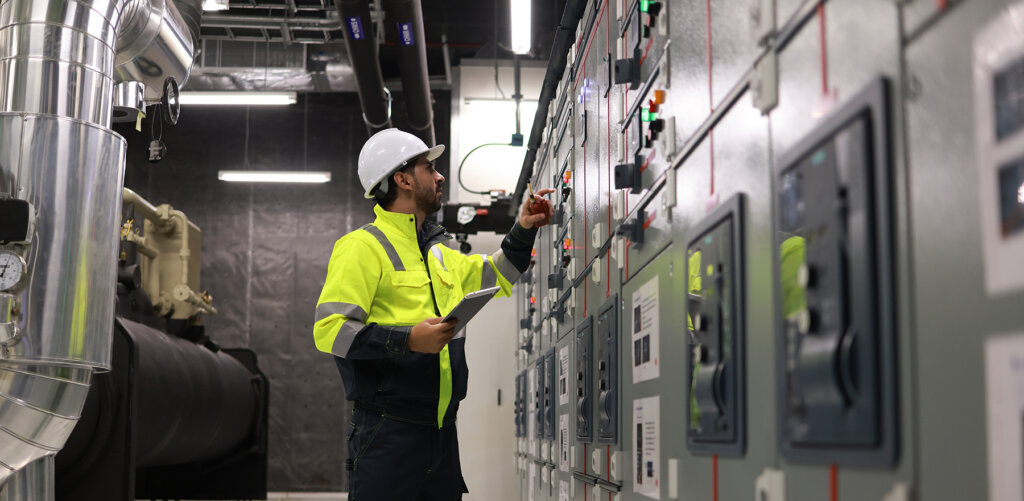
Example of inspection and field maintenance on electrical panels and switchgear.
Harmonic distortion is often caused by non-linear loads like variable frequency drives (VFDs) and switched-mode power supplies; and can therefore lead to excessive neutral currents, overheating of transformers, and increased losses in conductors. Voltage imbalance stresses three-phase motors, causing uneven current draw, increased vibration, and elevated operating temperatures. Repeated transient events (e.g., voltage spikes from switching operations or lightning strikes) can degrade insulation, damage semiconductor devices, and trigger nuisance tripping of protective relays.
Unlike catastrophic failures, the damage from chronic power quality issues accumulates incrementally. Insulation systems may experience accelerated breakdown due to persistent overvoltages or elevated temperatures. Electronic components such as capacitors, diodes, and integrated circuits can suffer from premature aging; while mechanical components like motor bearings are exposed to increased wear from electrical arcing or vibration. Over time, this leads to a higher incidence of faults, reduced mean time between failures (MTBF), and the need for more frequent maintenance interventions.
Facilities may find themselves replacing or overhauling equipment years before reaching its expected service life, resulting in unplanned capital expenditures and increased operational risk.
The gradual nature of this degradation often obscures the root cause, making it challenging to directly attribute costs to power quality issues. However, the cumulative financial impact can be significant … especially when critical assets require premature repair or replacement, and when unplanned downtime disrupts essential operations. Proactive monitoring and mitigation of power quality disturbances are essential to preserving equipment longevity and controlling long-term facility costs.
3. Increased Energy Consumption And Operating Expenses
Poor power quality impacts not only system reliability but also operational efficiency. Harmonic distortion (often introduced by non-linear loads such as variable frequency drives, LED lighting, and computer power supplies) causes current to flow at frequencies other than the fundamental. These harmonic currents increase resistive losses in conductors, transformers, and switchgear, resulting in additional heat generation throughout the electrical distribution system. Similarly, voltage imbalance forces three-phase equipment (especially motors and compressors) to draw uneven currents, further increasing I²R losses and reducing overall system efficiency.
The excess heat produced by these inefficiencies presents a secondary challenge: facilities must allocate additional resources to cooling systems to maintain safe operating temperatures. In critical environments like data centers, hospitals, and manufacturing plants where cooling infrastructure is already a major operational expense, even small increases in heat output can drive up energy consumption significantly. For example, the power usage effectiveness (PUE) metric in data centers can worsen as cooling systems work harder to offset the thermal load caused by poor power quality.
Over time, the cumulative effect of these inefficiencies can have a substantial impact on operating expenses … particularly in facilities with high-density electrical loads or continuous operations. Additionally, the increased thermal stress can accelerate the degradation of electrical and electronic components, compounding maintenance and replacement costs.
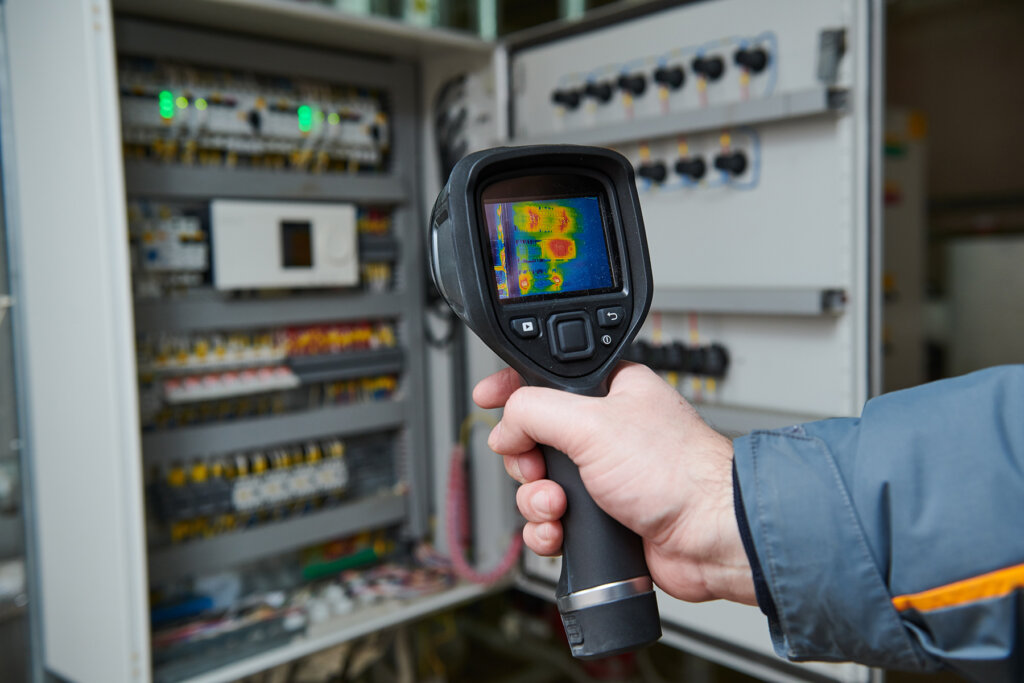
Example of thermal imaging showing hotspots in electrical equipment
By proactively addressing power quality issues through solutions such as voltage regulators, isolation transformers, and power conditioners; organizations can reduce energy waste, optimize cooling requirements, and improve the overall performance and longevity of their electrical infrastructure. This not only enhances operational efficiency but also delivers measurable savings on energy bills and reduces the facility’s environmental footprint.
These hidden losses do not typically trigger alarms or appear in maintenance logs, but they manifest as persistent increases in utility costs.
4. Higher Maintenance And Replacement Costs
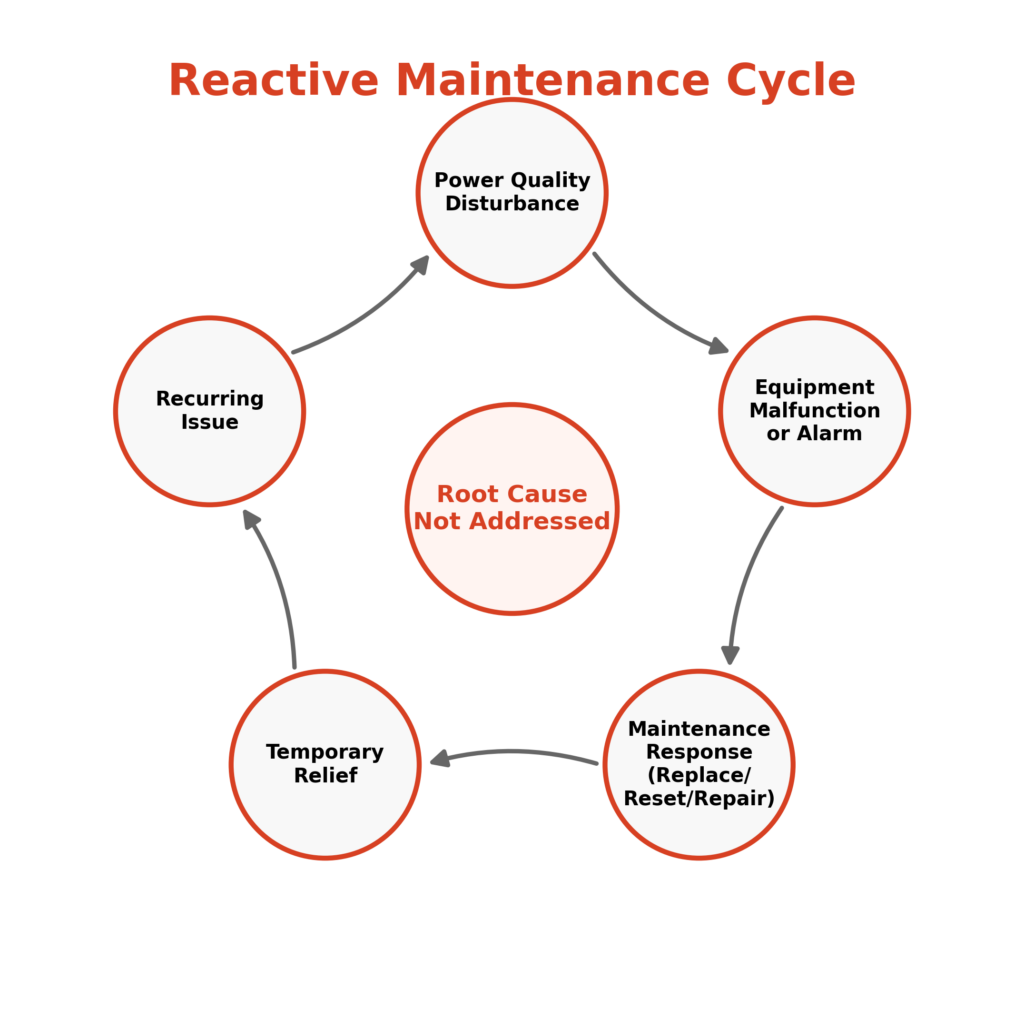
One of the most challenging aspects of poor power quality is its tendency to manifest as seemingly unrelated equipment malfunctions. Facilities may encounter nuisance tripping of circuit breakers, frequent alarms from building automation systems, unexplained resets of programmable PLCs, or intermittent failures in sensitive electronic devices. These symptoms often prompt maintenance teams to focus on the affected equipment by replacing circuit breakers, swapping out power supplies, recalibrating sensors, or updating firmware … without addressing the underlying electrical disturbances.
Power quality issues such as voltage sags, swells, harmonics, and transients can induce erratic behavior in a wide range of systems. For example, harmonics may cause protective relays to malfunction, while voltage transients can disrupt communication protocols or corrupt data in networked devices. In HVAC and lighting systems, voltage imbalance or momentary interruptions may trigger false alarms or force controllers into fault modes. As a result, maintenance personnel may spend significant time troubleshooting and performing corrective actions that provide only temporary relief.
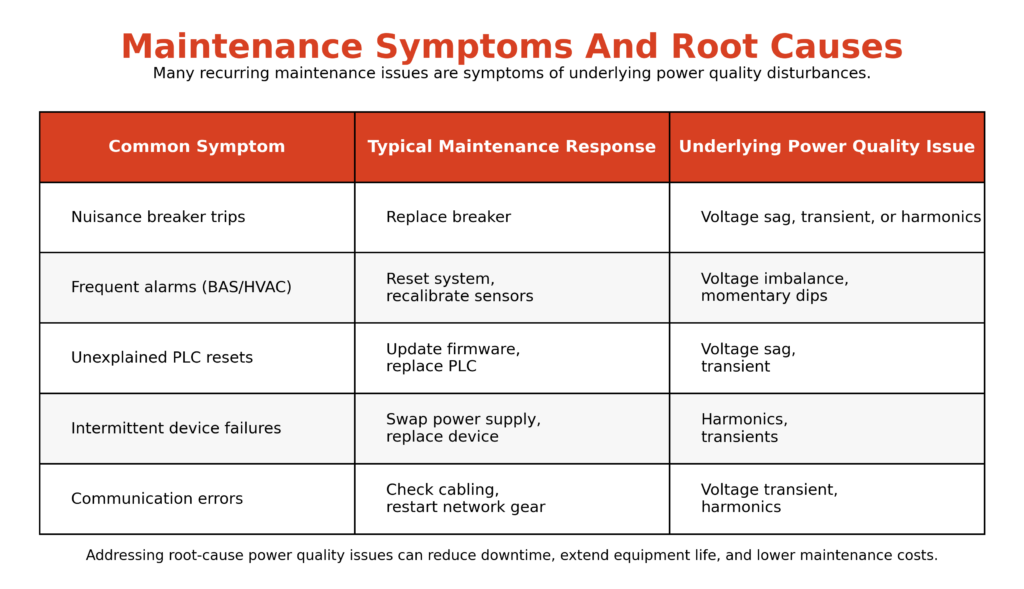
This reactive approach diverts resources from scheduled preventive maintenance and reliability-centered activities. Instead of optimizing system performance and extending asset life, teams become preoccupied with unplanned interventions and recurring service calls. Labor costs increase as technicians repeatedly address the same symptoms, and spare parts inventories may be depleted by unnecessary component replacements. The cumulative effect is a cycle of inefficiency, where maintenance budgets are consumed by avoidable issues rather than strategic improvements.
Without comprehensive power quality monitoring and root cause analysis, organizations risk remaining trapped in this cycle. The indirect costs (e.g., lost productivity, increased downtime, and diminished reliability) can be substantial … yet they often go unrecognized in traditional maintenance reporting. Proactive identification and mitigation of power quality disturbances are essential to breaking this cycle and optimizing maintenance resources.
For many critical facilities, these ongoing, reactive maintenance expenses represent one of the most significant and overlooked financial burdens associated with poor power quality.
Why Power Quality Matters More Than Ever
Power quality has become increasingly important as critical facilities, data centers, and utility systems rely on more sophisticated electrical and digital infrastructure. Today’s operations depend on advanced power electronics, automation systems, digital controls, communications networks, and other sensitive equipment that help improve efficiency, reliability, and performance. While these technologies provide significant benefits, they can also be more vulnerable to voltage fluctuations, harmonic distortion, and other power quality disturbances than traditional electrical systems.
For data centers, poor power quality can contribute to equipment alarms and cooling system anomalies. In critical facilities such as healthcare campuses, transportation hubs, and industrial operations, electrical disturbances can impact essential systems that support safety, productivity, and operational continuity. Utilities face similar challenges as grid modernization efforts introduce increasing numbers of electronic controls, distributed energy resources, and intelligent monitoring technologies throughout the electrical network.
Expectations for reliability and resiliency are increasing at a rapid rate. Organizations are expected to deliver continuous service, maximize uptime, and maintain operational continuity in increasingly complex environments. As electrical systems become more interconnected and dependent on sensitive technologies, the consequences of poor power quality and a reactive maintenance cycle become more costly and difficult to ignore.
Safeguard your organization against costly disruptions … don’t let poor power quality put your operations at risk. Partner with Trystar to prioritize power quality today!