Reliable electrical performance is the backbone of modern facilities, supporting everything from critical manufacturing processes to essential data center operations. As organizations expand and integrate advanced technologies, the complexity of their electrical load profiles increase … making systems more vulnerable to power disturbances. Even minor fluctuations in voltage or frequency can disrupt sensitive equipment … thus leading to costly downtime, data loss, or equipment damage. This heightened sensitivity demands a proactive approach to power management, where real-time monitoring and rapid diagnostics are essential for identifying and addressing issues before they escalate.
To ensure uninterrupted operations, organizations must move beyond traditional, reactive maintenance models and adopt comprehensive strategies for detecting and managing power distribution and power quality challenges. This involves deploying advanced monitoring infrastructure, leveraging data analytics for predictive insights, and implementing targeted mitigation solutions such as power conditioning and redundancy. By prioritizing the stability and integrity of their electrical infrastructure, businesses can not only safeguard their assets but also optimize energy efficiency and reduce operational risks.
Proactive monitoring and mitigation of power quality issues are essential for maintaining the reliability and efficiency of modern electrical infrastructure.
This article explores how organizations can proactively detect and manage power distribution and power quality challenges to ensure reliable electrical performance and operational continuity.
Understanding Power Distribution Challenges
Modern facilities face unprecedented complexity in their electrical distribution systems. The rapid evolution of technology, coupled with the drive for greater efficiency and flexibility, has transformed once-stable power networks into dynamic environments. As organizations expand, reconfigure, and integrate new equipment, the demands placed on electrical infrastructure intensify. This environment requires a deeper understanding of the unique challenges that arise within power distribution systems to ensure both reliability and safety.
These challenges are not limited to the visible components of the electrical network. Hidden vulnerabilities (e.g., such as aging infrastructure, more non-linear loads, increased network complexity, and the integration of distributed energy resources) can undermine system performance. Addressing these issues requires an integrated approach that considers both legacy and emerging risks, as well as the interplay between different elements of the distribution architecture.
Aging or Capacity‑Limited Infrastructure
Many facilities continue to rely on electrical infrastructure that was designed decades ago, often for much lower load requirements than those seen today. Legacy switchgear, feeders, and branch circuits may lack the capacity to handle modern demands, resulting in increased thermal stress and a higher likelihood of component failure. As equipment ages, insulation degrades and connections loosen …further reducing the system’s ability to withstand faults or surges.
The consequences of operating with outdated or undersized infrastructure are significant. Reduced fault tolerance means that even minor disturbances can escalate into major outages or equipment damage. Operational margins shrink, leaving little room for error or unexpected load increases. To maintain reliability, organizations must regularly assess the condition and capacity of their electrical systems … prioritizing upgrades and preventive maintenance.
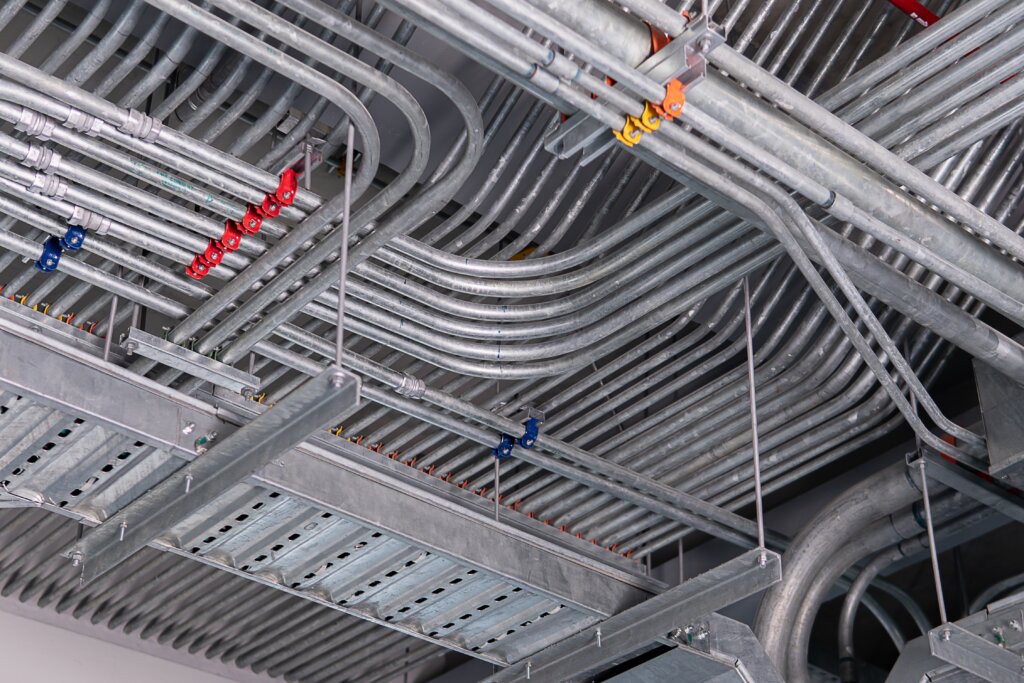
Example of an overcrowded electrical conduit layout for cable routing, with minimal room for expansion.
Prevalence of Non‑Linear and Distorting Loads
The widespread adoption of variable-speed drives, LED lighting, computing equipment, and other power electronics has fundamentally changed the nature of electrical loads. Unlike traditional linear loads, these devices draw current in abrupt pulses, injecting harmonic currents into the distribution system. Harmonics distort voltage waveforms, reduce overall efficiency, and increase losses throughout the network.
This distortion leads to elevated conductor heating, which can accelerate insulation breakdown and shorten equipment lifespan. Additionally, harmonics can interfere with the operation of protective devices, causing nuisance tripping … or, conversely, preventing devices from responding to genuine faults. Effective management of non-linear loads requires the use of harmonic filters, careful load balancing, and ongoing monitoring to identify and mitigate emerging issues.
Expanded Network Complexity
As facilities grow and adapt to changing operational needs, their electrical distribution networks often become more intricate. Equipment additions, floor layout changes, and ad hoc modifications can result in undocumented circuits and convoluted wiring paths. This lack of documentation makes troubleshooting and maintenance more challenging, increasing the risk of errors and prolonged downtime.
Network complexity also introduces technical challenges such as unbalanced phases, undersized feeders, and inconsistent grounding practices. These issues can cause voltage fluctuations, equipment malfunctions, and even safety hazards. Proactive documentation, regular audits, and adherence to best practices in network design are essential for maintaining stability and minimizing risks associated with complex distribution systems.
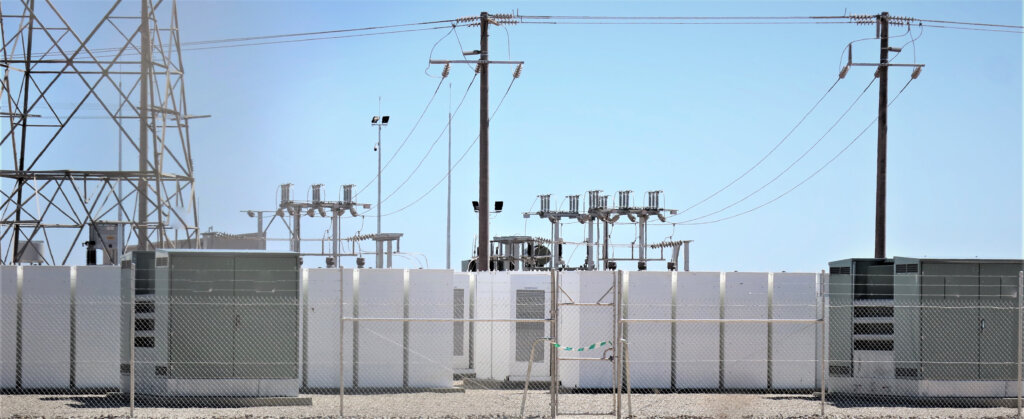
Example of BESS and switchgear at a renewable energy farm.
Integration of Distributed Energy Resources (DERs)
The integration of distributed energy resources such as solar arrays, battery storage, and engine-generators adds a new layer of complexity to power distribution. Unlike traditional systems with unidirectional power flow, DERs introduce bidirectional currents that can complicate voltage regulation and protective device coordination. These resources require advanced control strategies to ensure seamless operation alongside the utility grid.
DERs also present unique challenges in terms of system protection and reliability. The presence of multiple power sources can create fault currents that exceed the capabilities of existing protective devices or cause coordination issues between devices. Careful planning, robust interconnection standards, and the use of intelligent relays and controllers are necessary to manage these complexities and fully realize the benefits of distributed generation.
Effectively managing power distribution challenges requires a comprehensive understanding of both legacy vulnerabilities and emerging complexities, supported by proactive assessment, documentation, and the adoption of advanced mitigation strategies.
Common Power Quality Issues and Their Impact
Power quality issues are pervasive in modern electrical systems, often as subtle disturbances that undermine operational efficiency and equipment reliability. While these disturbances may not always cause immediate failures, their cumulative effects can be significant … leading to increased maintenance costs, unexpected downtime, and reduced asset longevity. As facilities become more dependent on sensitive electronics and automated processes, the consequences of poor power quality grow more severe, impacting everything from production throughput to data integrity.
Understanding the most common power quality issues is essential for effective risk management and system optimization. By identifying and addressing these disturbances proactively, organizations can protect critical assets, maintain process stability, and avoid costly disruptions. The following are the most prevalent power quality challenges and their impacts on facility operations:
- Voltage Sags, Swells, and Interruptions:
Short-duration voltage fluctuations can cause nuisance tripping of circuit breakers, reset programmable logic controllers (PLCs) and drives … all of which can result in motor torque loss, erratic process behavior, and operation downtime.
- Transient Overvoltage Events:
Microsecond-scale voltage spikes … often triggered by switching operations, capacitor bank actions, or lightning … can damage sensitive control electronics and instrumentation, leading to premature equipment failure.
- Harmonic Distortion:
The presence of harmonics increases transformer and conductor heating, reduces overall power factor, and can cause false triggering or malfunction in sensitive electronic equipment.
- Load Imbalance and Poor Power Factor:
Unbalanced phases generate excess neutral current and increase system losses … while a low power factor raises utility charges and places additional stress on upstream distribution components.
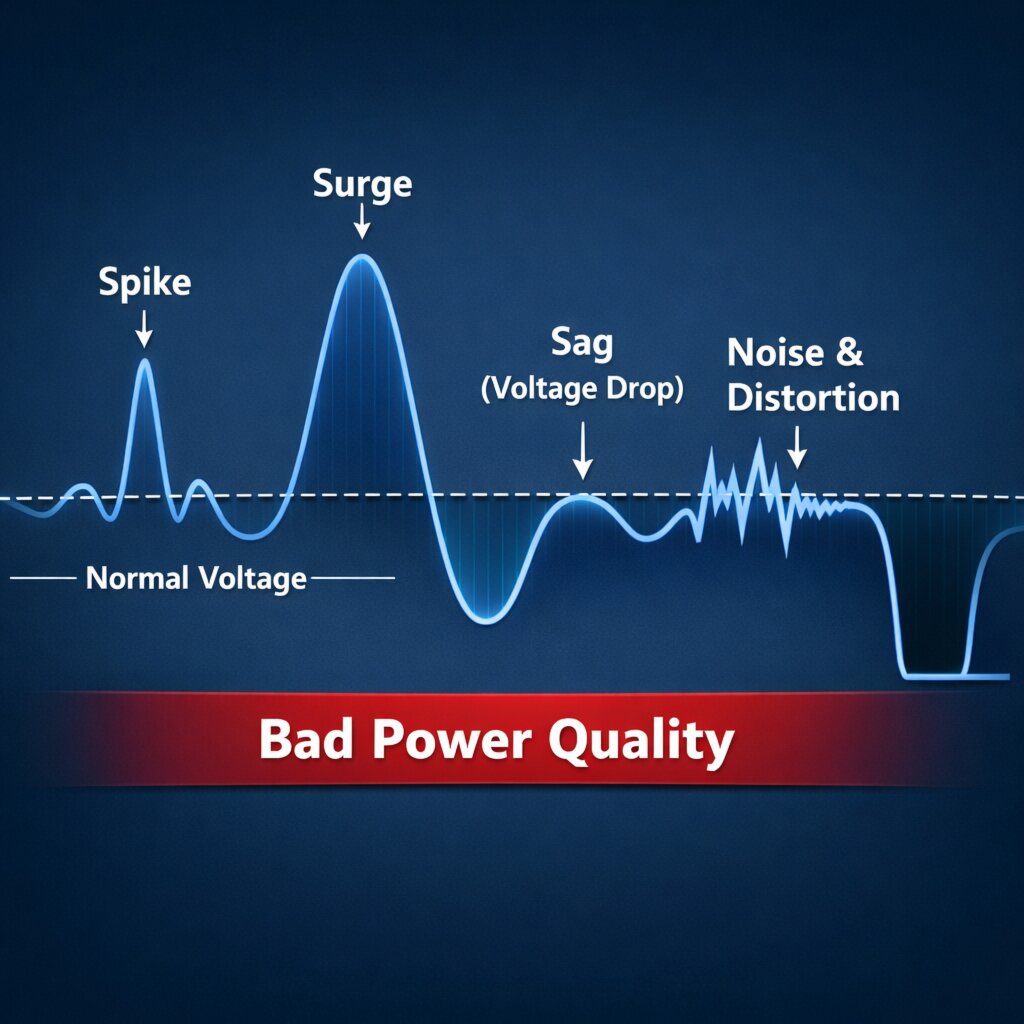
Examples of electrical power quality anomalies. “Clean” power is represented by a pure sine wave.
Proactively identifying and mitigating common power quality issues is essential for preserving equipment health, optimizing operational efficiency, and ensuring the long-term reliability of facility electrical systems.
Detection Methods for Power Distribution and Quality Issues
Effective detection of power distribution and power quality issues is of primary importance to maintaining electrical reliability in modern facilities. As electrical systems grow in complexity, traditional spot-checks and manual inspections are no longer sufficient to capture the full spectrum of disturbances that can impact performance. Comprehensive visibility enabled by advanced monitoring and analytical tools empowers organizations to move from reactive troubleshooting to proactive management, reducing downtime and preventing costly failures.
A robust detection strategy leverages a combination of continuous monitoring, sophisticated analytics, and detailed event recording to provide actionable insights. By systematically capturing and analyzing power system data, facility managers and engineers can pinpoint vulnerabilities, track degradation trends, and implement targeted interventions. The following methods represent best practices for detecting and diagnosing power distribution and quality challenges:
- Permanent Power Quality Monitoring:
Continuous metering captures sags, swells, harmonics, transients, and imbalance events in real time, providing high-resolution waveform detail, event timestamping, and trend identification. Trystar’s monitoring and controls solutions deliver real-time visibility and control across critical power systems, helping facilities proactively prevent failures and maintain optimal performance.
- Advanced Analytical Platforms:
Analytics correlate data across feeders, phases, and events, enabling root-cause identification, predictive fault detection, and long-term degradation trend analysis. Trystar’s monitoring and controls offerings also integrate advanced analytics to transform raw data into actionable insights for improved system reliability.
- Event Logging and Sequence‑of‑Events Recording:
Time-aligned event logs allow engineers and facility managers to identify the origin and path(s) of disturbances … thus enabling accurate corrective action. Trystar partners with critical facilities to implement sequence-of-event recording and remote diagnostics, supporting rapid troubleshooting and continuous improvement.
- Load Studies and Capacity Assessments:
Long-duration load recording identifies overloaded circuits, insufficient capacity, poor load distribution, and equipment cycling patterns that affect stability. These assessments provide the data needed to optimize load balancing and plan for infrastructure upgrades, supporting long-term operational resilience.
Comprehensive detection methods are essential for proactively identifying, diagnosing, and addressing power distribution and quality issues, ensuring long-term system reliability and operational excellence.
Strategies for Managing and Improving Power Quality
Once power quality disturbances are identified, facilities must implement targeted strategies to mitigate risks and enhance system performance. Effective management goes beyond temporary fixes … requiring engineered solutions that address the root causes of instability and inefficiency. By tailoring mitigation measures to the unique characteristics of each facility, organizations can ensure reliable operations, protect critical assets, and comply with industry standards.
A comprehensive approach to power quality management combines technical interventions, system upgrades, and ongoing maintenance. Leveraging Trystar’s custom capabilities and services enables facilities to deploy proven solutions for load balancing, harmonic mitigation, voltage regulation, grounding, and preventive maintenance. The following strategies represent best practices for managing and improving power quality:
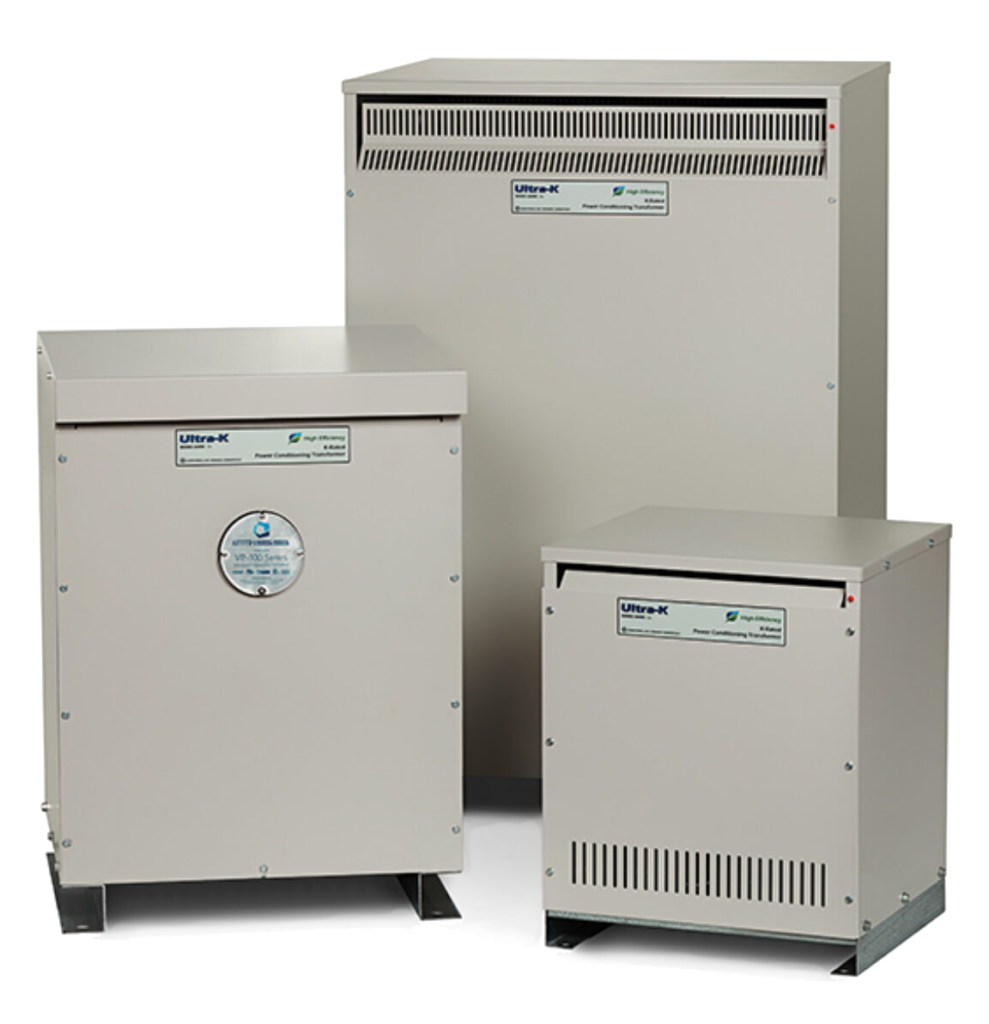
Trystar’s ULTRA-K Series 600K-he is a high-efficiency, K-rated power conditioning transformer
- Load Balancing and Circuit Reconfiguration:
Equalizing loads across all phases reduces electrical losses, stabilizes voltage profiles, and enhances overall system performance. By distributing electrical demand evenly, facilities can prevent overheating of conductors and transformers, minimize voltage imbalances, and extend equipment lifespan. This approach also improves energy efficiency and supports more reliable operation of sensitive electronic devices.
- Harmonic Mitigation Techniques:
Passive and active filters, line reactors, isolation transformers, and multi-pulse drive configurations are effective in reducing harmonic distortion and protecting sensitive equipment. Power conditioners and voltage regulators help mitigate harmonics and maintain clean power delivery.
- Voltage Regulation and Power Conditioning:
Uninterruptible power supplies (UPS) and power conditioning voltage regulators maintain consistent voltage levels, as well as protect sensitive loads from sags, swells, and brief interruptions. These solutions automatically compensate for fluctuations in the incoming power supply … thus ensuring that critical equipment continues to operate smoothly even during power anomalies and electrical disturbances. By providing a stable and clean power source, they help prevent data loss, equipment malfunctions, and costly downtime … therefore making them essential components in environments where reliability is of utmost importance.
- Grounding and Bonding Improvements:
A well-engineered grounding and bonding system lowers fault impedance, enhances transient response, and stabilizes equipment operation under varying load conditions. Proper grounding ensures that electrical faults are safely and efficiently directed away from sensitive equipment, reducing the risk of damage or operational disruptions. Additionally, effective bonding minimizes voltage differences between conductive parts, further improving safety and system reliability.
- Preventive and Predictive Maintenance:
Routine thermographic inspections, breaker testing, torque verification, and periodic system audits are essential for reducing failure risk and maintaining distribution integrity. Trystar’s Services offerings include comprehensive preventive maintenance plans and expert field service … thus ensuring that electrical systems are regularly inspected, tested, and optimized for peak performance. Skilled technicians provide on-site diagnostics, corrective actions, and tailored maintenance schedules, which enable facilities proactively address potential issues and extend the lifespan of critical power infrastructure.
Implementing engineered mitigation strategies supported by advanced solutions and preventive maintenance empower facilities to address power quality challenges at their source … thereby ensuring long-term reliability, safety, and operational excellence.
Conclusion
Electrical reliability hinges on the ability to accurately detect and continuously monitor power distribution and quality challenges. As facility loads increase and equipment becomes more sensitive, the risks associated with undetected disturbances and system vulnerabilities grow exponentially. Implementing advanced monitoring, analytics, and event recording not only provides real-time visibility but also empowers organizations to identify and address issues before they escalate into costly failures or operational disruptions.
To truly safeguard assets and maintain peak system performance, proactive power quality management must be paired with engineered mitigation strategies and ongoing preventive maintenance. By investing in comprehensive solutions and expert support, facilities can minimize downtime, extend equipment lifespan, and ensure operational excellence.
Take decisive action today … partner with a trusted power solutions provider to elevate your facility’s electrical reliability and secure your organization’s future.