Critical facilities such as data centers, hospitals, water/wastewater treatment plants, industrial campuses, and emergency response centers all depend on uninterrupted electrical service to maintain life safety, operational continuity, and regulatory compliance. In these environments, power failure is not an inconvenience; it is a risk event with operational, financial, and reputational consequences. Rising load densities, aging infrastructure, and tighter uptime guarantees mean that yesterday’s distribution strategies often fall short of today’s reliability expectations.
Specifying engineers and electrical distributors play a central role in designing and delivering mission critical power systems that eliminate single points of failure and maintain uptime under extreme conditions. Effective power distribution system designs within critical facilities require more than standard electrical distribution … they demand engineered redundancy, selective coordination, robust protection schemes, and integrated monitoring systems. Modern critical facility power systems must balance reliability, scalability, speed-to-deployment, and compliance with NEC, NFPA, IEEE, and UL requirements.
For specifying engineers, distributors, and facility leaders, this overview provides a clear, practical guide for designing redundant, code‑compliant, and future‑ready power distribution systems … all of which support uptime, safety, and regulatory confidence. Additionally, this article examines the architecture, redundancy strategies, protection mechanisms, and monitoring technologies that define resilient power infrastructure … as well as how engineered distribution solutions support these objectives.
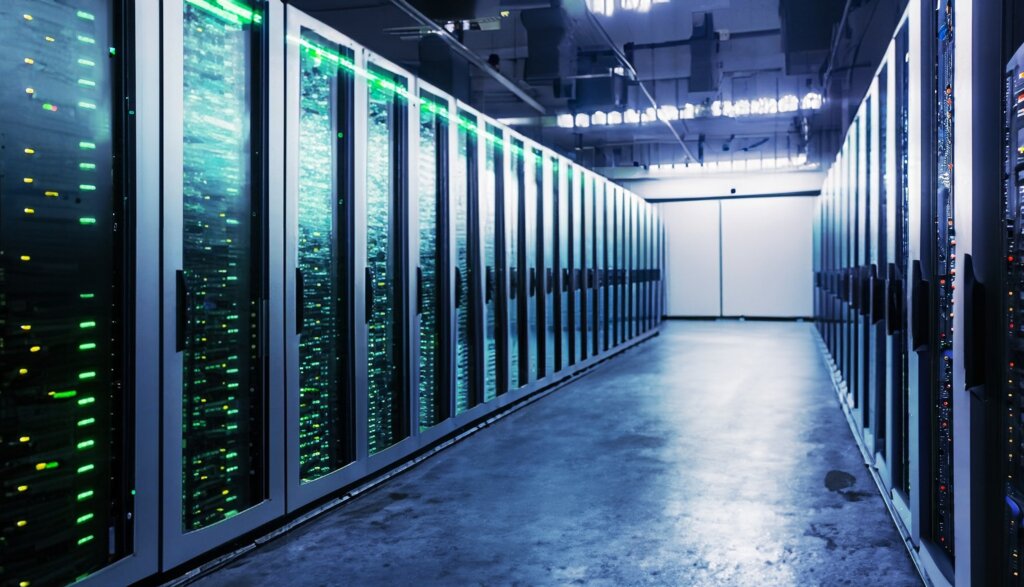
Example of high-density server racks within a mission-critical data center. This type of data center environment requires resilient power distribution, UPS systems, and a redundant electrical infrastructure.
Power Distribution Architecture in Critical Facilities
A reliable power distribution system starts at the service entrance, where utility power enters the facility and is initially managed, metered, and protected by main switchgear and protective devices. From there, electricity is routed through medium-voltage distribution systems, which efficiently transmit power over longer distances within the facility before being stepped down to low-voltage for localized distribution. Low-voltage panels then distribute electricity to final branch circuits, which deliver power directly to equipment, lighting, and other end-use devices, ensuring safe and efficient operation throughout the facility.
Medium Voltage Distribution
In large facilities, medium voltage switchgear distributes utility or on-site generation power … thus serving as the central control point to isolate faults and enable safe maintenance without disrupting power to the entire facility. Engineers often specify metal-clad switchgear, arc-resistant switchgear, and integrated protection relays to ensure personnel safety and the reliability of power distribution across complex campus environments.
Critical considerations include:
- Short circuit ratings and interrupting capacity to ensure the switchgear can safely interrupt high fault currents without damage, protecting both equipment and personnel.
- Protective relay coordination to prevent unnecessary power outages by ensuring only the affected section of the system is isolated during a fault.
- Arc flash mitigation strategies to reduce the risk and severity of arc flash incidents, safeguarding workers and minimizing equipment damage.
- Maintainability and front/rear access requirements enable safer, faster service and reduce system downtime.
By synchronizing multiple generators, paralleling switchgear allows for seamless load sharing and automatic transfer of power in the event of a generator failure. This configuration not only enhances system reliability and uptime but also provides flexibility for maintenance without interrupting critical facility operations.
Transformers And Substations
Substation transformers, including pad-mounted transformers and dry type transformers for data centers, step voltage levels appropriately for facility loads. Increasingly, engineers specify K-rated transformers or harmonic mitigating transformers to manage nonlinear loads introduced by UPS systems, VFDs, and IT equipment. K-rated and harmonic mitigating transformers are designed to handle the additional heat and electrical distortion caused by nonlinear loads, which are common in modern critical facilities. By minimizing the effects of harmonics, these specialized transformers help maintain power quality, improve equipment lifespan, and reduce the risk of overheating or electrical failures.
In high-density applications, transformer placement, thermal management, and harmonic performance directly impact long-term reliability. Proper transformer placement ensures adequate airflow and accessibility for maintenance, while effective thermal management prevents overheating that can degrade performance or shorten equipment life. Optimizing harmonic performance reduces electrical noise and stress on both transformers and connected devices, supporting consistent and reliable operation in demanding environments.
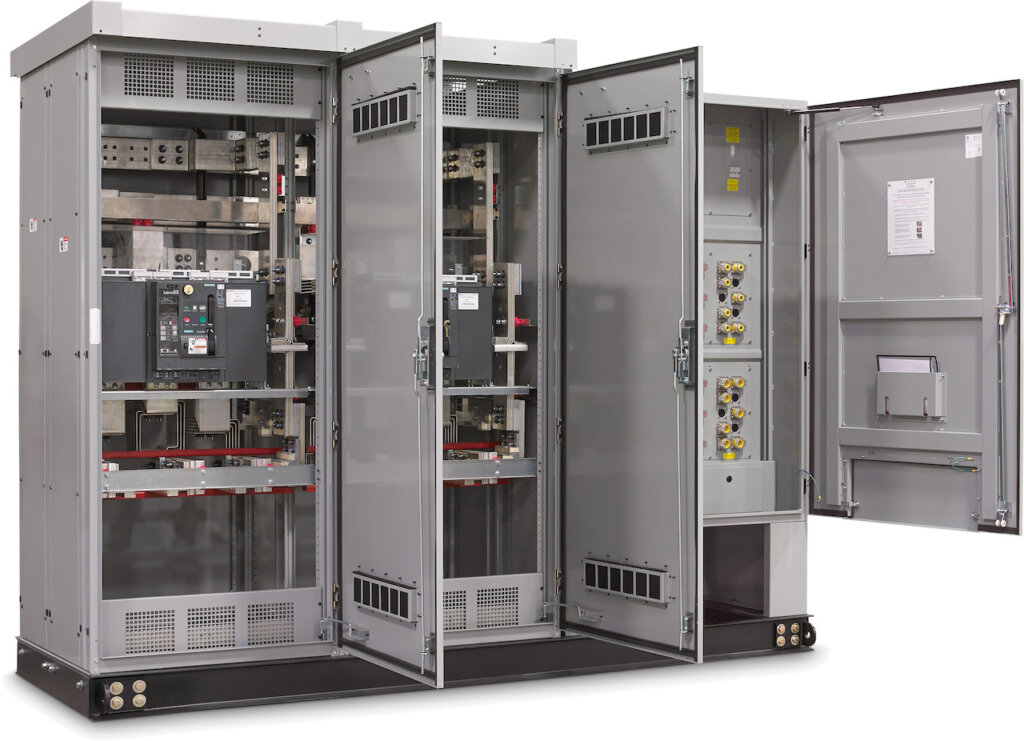
Example of a Trystar UL 891 Listed Low-Voltage Switchboard.
Low Voltage Distribution
Downstream, low voltage switchgear, UL 891 switchboards, and panelboards distribute power to mechanical, IT, and life-safety systems. Proper selective coordination studies and short circuit coordination studies ensure faults are isolated locally without cascading outages. Selective coordination studies identify and set protective devices so that only the circuit closest to a fault disconnects, preventing unnecessary power loss to other areas. Short circuit coordination studies verify that all equipment can safely withstand and interrupt potential fault currents, ensuring both personnel safety and system integrity throughout the facility.
For mission critical environments, power distribution equipment must:
- Withstand high fault currents to protect equipment and personnel by preventing catastrophic failures during electrical faults.
- Maintain selective tripping to ensure only the affected circuit is disconnected, thus preserving power to the rest of the facility.
- Support closed transition switching to allow seamless power transfers without interruption, which is vital for continuous operation.
- Enable rapid maintenance or isolation to minimize downtime and support ongoing reliability in mission critical operations.
Custom-engineered assemblies that integrate switchgear, transformers, and protection in compact footprints provide installation efficiency and reduce field coordination risk … an area where engineered power distribution manufacturers deliver strong value.
Redundancy and Reliability Strategies
Reliability within critical facility power distribution is defined by architecture. Engineers commonly deploy one or more of the following strategies:
- N+1 power redundancy provides one additional backup component for every N primary component, ensuring continued operation even if a single component fails.
- 2N power architecture duplicating the entire power system, offering a fully redundant path so that maintenance or failure in one system does not impact operations.
- 2N+1 configurations combining full system duplication with an extra backup component, further increasing fault tolerance.
- Tier III power design requires multiple independent power paths and the ability to maintain and replace equipment without shutting down critical loads.
- Tier IV data center power systems offering the highest level of redundancy and fault tolerance, capable of withstanding multiple simultaneous failures without service interruption.
These configurations eliminate single points of failure and provide fault-tolerant pathways from utility to load. To achieve true reliability, redundancy, and resilience in critical facility power distribution, it is essential to integrate multiple layers of backup and transfer systems. Backup power generation, transfer systems, and uninterruptible power supplies (UPS) work together to ensure continuous power availability, protect sensitive equipment, and maintain operational continuity even during utility failures or maintenance events.

Robust power distribution architectures (e.g., N+1, 2N, and Tier-rated designs) are essential for eliminating single points of failure and ensuring continuous operation in critical facilities.
Backup Generation
Emergency generator systems, including diesel or natural gas units, form the backbone of standby power. Facilities often deploy standby generators for hospitals or industrial campuses in redundant arrangements with generator paralleling switchgear to balance loads and provide seamless transition. To ensure continuous power during generator maintenance or unexpected failures, many critical facilities integrate generator docking stations. These stations allow safe, code-compliant, and rapid connection of a temporary or portable generator without opening switchgear or exposing operators to energized equipment. Docking stations greatly reduce outage risk during planned service windows and provide a reliable contingency during emergencies.
Transfer Systems
Automatic transfer switches (ATS) and bypass isolation transfer switches provide reliable transitions between utility and generator power. In high-availability environments, static transfer switches (STS) enable near-instantaneous switching between redundant power sources for critical loads. Closed transition transfer switches prevent interruption during source transfer, which is particularly important in facilities sensitive to voltage sag.
Uninterruptible Power Supply (UPS)
UPS systems for critical loads protect against short-duration outages and bridge the gap until generator systems stabilize. Engineers must account for battery runtime requirements, maintenance bypass configurations, and any harmonic impact on upstream distribution. Effective redundancy design integrates generators, transfer switches, UPS systems, and distribution switchgear into a cohesive architecture rather than isolated components.
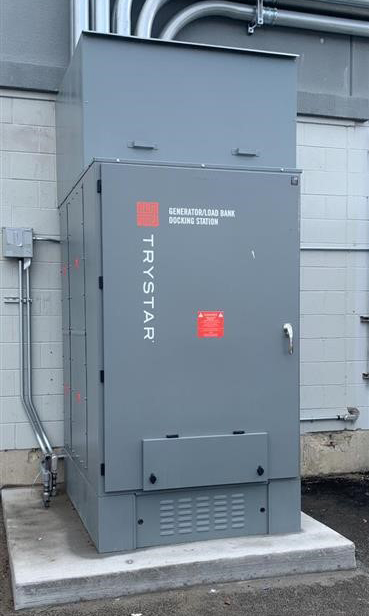
A typical Trystar generator docking station.
Power Quality, Protection, and Safety
Power reliability extends beyond uptime. Power quality analysis identifies and addresses issues such as voltage sags, swells, transients, and harmonics that can degrade equipment performance or cause failures over time. Implementing robust surge protection safeguards sensitive electronics from damaging voltage spikes, while comprehensive arc flash mitigation strategies reduce the risk of dangerous electrical incidents, protecting both personnel and infrastructure and supporting the long-term integrity of the entire power distribution system.
In addition to ensuring continuous power delivery, maintaining the integrity and safety of a critical facility’s electrical infrastructure requires proactive management of power quality and electrical hazards. Harmonics control, surge protection, grounding, and arc flash mitigation all safeguard equipment, enhance system stability, and protect personnel. Each of these practices are vital for sustaining long-term reliability in mission-critical environments.
Harmonics and Voltage Stability
Nonlinear loads generate harmonic distortion that increases heating and reduces transformer lifespan. Specifying engineers often implement harmonic mitigating transformers and power monitoring equipment. Additionally, voltage sag mitigation and proper load balancing are essential in high-density data centers and healthcare environments.

Example of typical arc flash labeling compliance.
Surge Protection and Grounding
Surge protection devices (SPD) and transient voltage surge suppression (TVSS) protect sensitive equipment from switching events and lightning-induced surges. Grounding and bonding practices (especially those in power grid substations and campus-style facilities) must comply with IEEE and NEC standards.
Arc Flash Mitigation
Arc flash hazards present both safety and compliance challenges. These types of solutions often include arc-resistant switchgear, energy-reducing maintenance switches, and arc flash labeling compliance. Engineered switchgear solutions that integrate safety features reduce risk for operations personnel and service contractors.
Effective power quality management, surge protection, and arc flash mitigation are vital for protecting both equipment and personnel, supporting long-term system integrity.
Monitoring, Controls, and Digital Power Infrastructure
As facilities grow more complex, real-time visibility into system performance becomes critical. Modern electrical power monitoring and controls, as well as energy management systems provide actionable data to operators … therefore enabling them to detect anomalies, optimize energy usage, and respond quickly to potential issues. These systems support predictive maintenance, enhance operational efficiency, and help ensure compliance with regulatory standards by delivering detailed insights into power quality, load trends, and equipment status across the entire facility.
As critical facilities evolve, the integration of advanced monitoring, digital technologies, and distributed energy resources becomes essential for maintaining reliability and operational excellence. Remote monitoring, cybersecurity, and future-ready infrastructure not only enhance system oversight and resilience, but also position facilities to adapt to emerging technologies and energy strategies … thus ensuring long-term sustainability and competitive advantages.
Remote Monitoring and Predictive Maintenance
Remote power monitoring and substation monitoring systems allow facility teams to detect abnormal conditions, identify breaker wear, and track load trends. Integrated metering within smart switchgear enables centralized control and reporting. For electrical distributors, offering integrated monitoring capabilities adds long-term value beyond hardware delivery.
Cybersecurity and Digital Integration
As power distribution systems become more interconnected and reliant on digital controls, they present new entry points for cyber threats that could disrupt operations or compromise sensitive data. To mitigate these risks, engineers must implement robust cybersecurity measures (e.g., network segmentation, access controls, and regular vulnerability assessments) while ensuring that authorized personnel can still efficiently monitor and manage critical systems.

Example of digital and remote power monitoring within a facility.
Preparing for Distributed Energy Resources
Future-ready critical facility power systems are beginning to integrate onsite solar power generation, battery energy storage systems (BESS), and microgrids. Distribution infrastructure must accommodate bidirectional power flow, scalable expansion, and modular upgrades. Engineered, factory-integrated power distribution assemblies reduce field installation complexity and improve commissioning timelines: an important differentiator for fast-track projects.
Real-time monitoring, predictive maintenance, and strong cybersecurity protocols are increasingly important as facilities adopt digital and connected power systems.
Preparing for distributed energy resources and scalable, modular upgrades positions facilities to adapt to evolving technologies and energy demands.
Conclusion
Power distribution within critical facilities demands engineered resilience. Specifying engineers must design redundant power distribution systems that eliminate single points of failure, meet stringent compliance requirements, and deliver long-term reliability. Electrical distributors must source solutions that balance customization, lead time, and performance.
From medium voltage switchgear and substation transformers to automatic transfer switches, generator paralleling switchgear, and integrated monitoring platforms, every component contributes to mission continuity.
Ready to elevate your facility’s power reliability and resilience? Trystar provides custom-engineered, power distribution solutions that reduce field coordination risk, simplify installation, and support rapid commissioning … all of which are especially valuable in fast‑track or high‑reliability environments. Connect with Trystar to request a short consultation to review your redundancy strategy, coordination study requirements, or fast‑track deployment needs.