In any electronic system, stable voltage is essential. Whether you’re powering industrial controls, medical equipment, or sensitive digital electronics, even small voltage variations can lead to inaccurate readings, erratic behavior, or component damage. Two of the most important specifications used to describe voltage stability in power supplies are line voltage regulation and load voltage regulation. Although they sound similar, they measure different stress conditions and both are critical to reliable system design.
In any electric system, maintaining a stable voltage is fundamental to ensuring reliable performance and protecting sensitive components. Voltage fluctuations, even within a narrow range, can introduce significant risks ranging from data corruption in digital circuits to premature failure of analog sensors and actuators. This is particularly critical in environments such as industrial automation, medical instrumentation, and telecommunications where precise voltage control underpins both safety and operational accuracy. Electrical power equipment must deliver consistent voltage, regardless of external disturbances or internal changes in demand.
Two primary specifications define how well a power supply maintains this stability: line voltage regulation and load voltage regulation. Line voltage regulation measures a power supply’s ability to maintain its output voltage as the input (or line) voltage varies within specified limits. This is essential when the supply is connected to utility power or generators, where input voltage can fluctuate due to grid instability or load switching. On the other hand, load voltage regulation quantifies the supply’s response to changes in the load current … that is, how well it holds the output voltage steady as the connected devices draw more or less power. Both forms of regulation are vital, as real-world systems are subject to both input disturbances and dynamic load conditions.
Reliable system design requires equal attention to both line voltage regulation and load voltage regulation, as each addresses a critical aspect of voltage stability essential for uninterrupted, accurate, and safe operation.
What Is Line Voltage Regulation?
Line voltage regulation quantifies a power supply’s ability to maintain a consistent output voltage despite fluctuations in the input voltage, provided the load remains unchanged.
This specification is critical in applications where the input source (e.g., utility, generator, or battery power) is prone to variation due to factors like grid instability, generator load changes, or voltage drops across long cable runs. When line regulation is poor, even minor deviations in the input voltage can spread directly to the output … potentially damaging sensitive electronic components, producing logic-level errors in digital circuits, or degrading the accuracy of precision instrumentation.
Typical causes of input voltage variation include:
- Utility voltage fluctuations, which can occur due to changes in demand or faults in the distribution network.
- Generator power, where output voltage may vary with load or engine speed.
- Long cable runs or shared power sources, where voltage drops can result from resistance or competing loads.
In each of these scenarios, the power supply must compensate for input changes to prevent downstream equipment from experiencing harmful voltage swings.
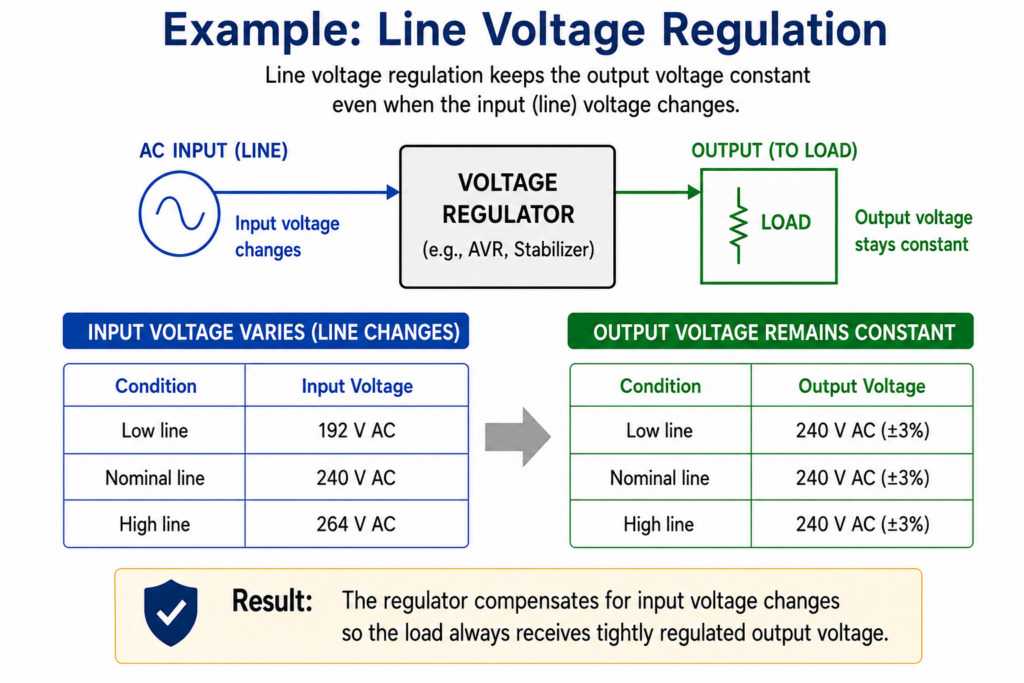
Line voltage regulation is especially vital in environments with unstable or poorly regulated input power … such as industrial facilities, remote installations, or mobile systems. By ensuring that output voltage remains steady regardless of input fluctuations, robust line regulation protects equipment, maintains operational accuracy, and upholds system reliability.
What Is Load Voltage Regulation?
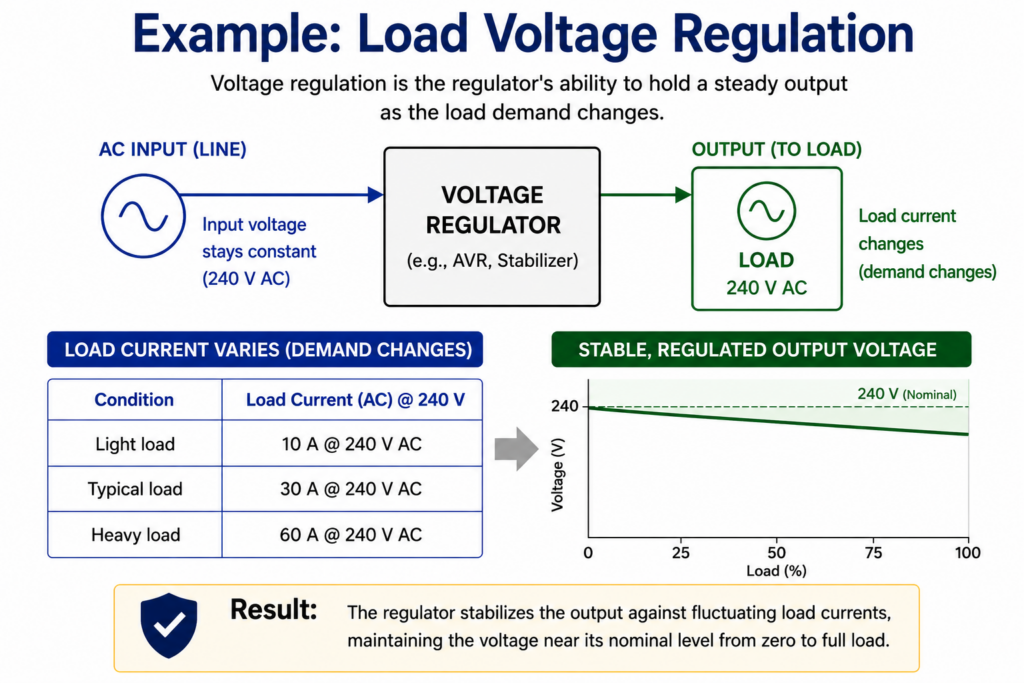
Load voltage regulation evaluates a power supply’s ability to maintain a stable output voltage as the load current varies, assuming a constant input voltage.
This specification becomes crucial in systems where the current drawn by connected devices can change rapidly or unpredictably (e.g., in industrial automation, embedded electronics, or communication infrastructure). When load regulation is inadequate, the output voltage may “droop” under heavy loads or rise when demand decreases, leading to operational instability and potential equipment malfunction.
Real-world examples of load changes include:
- Motors starting or stopping, which can cause sudden surges or drops in current demand.
- Microcontrollers switching between active and low-power states, resulting in rapid fluctuations in load.
- Communication devices transmitting data, which often draw variable current depending on transmission cycles.
- Heaters or actuators cycling on and off, introducing periodic changes in current consumption.
In each scenario, the power supply must respond quickly and accurately to maintain voltage stability.
Poor load regulation can shift logic thresholds in digital circuits, introduce noise or offset errors in sensitive analog systems, and cause resets or malfunctions during peak load conditions. Therefore, robust load regulation is essential for systems with dynamic or unpredictable current demands, ensuring reliable performance, data integrity, and protection of critical components.
Key Differences Between Line and Load Voltage Regulation
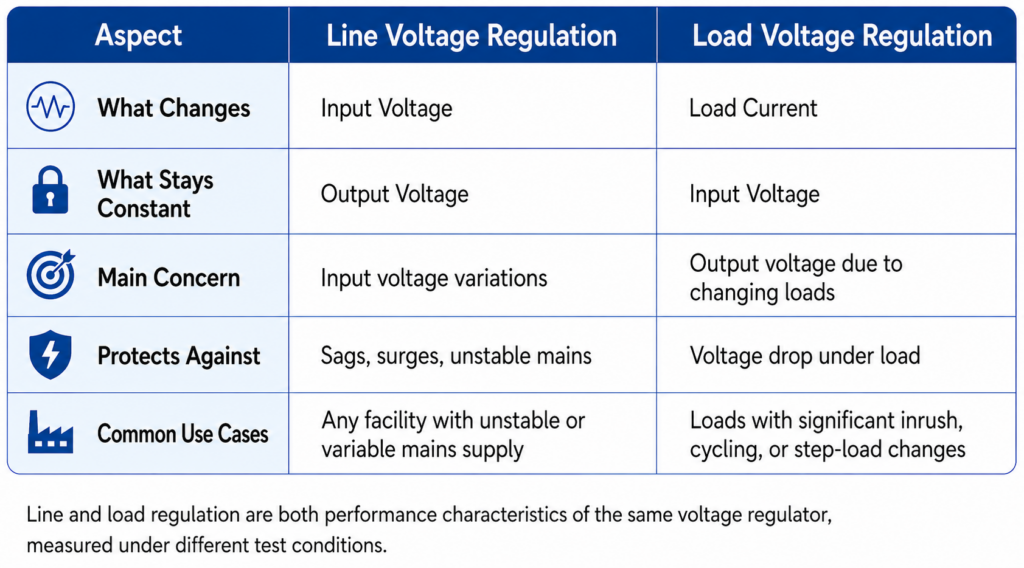
Both line voltage regulation and load voltage regulation are prominently featured on power supply and voltage regulator datasheets because they assess distinct failure modes that can compromise system performance. Line voltage regulation evaluates the supply’s resilience to input voltage fluctuations, while load voltage regulation measures its ability to maintain output stability under varying load conditions. By specifying both parameters, manufacturers provide engineers with a comprehensive understanding of how a power supply will perform in real-world scenarios … thus enabling informed component selection and robust system design.
Why Both Matter in Power System Design
Input voltage and load current frequently fluctuate simultaneously, presenting a complex challenge for power system design. A robust power system must be capable of compensating for both input disturbances and dynamic load changes to ensure continuous, stable operation. For example:
- In a factory control panel, the activation of large machinery can cause significant dips in line voltage.
- While simultaneously, control electronics may concurrently demand increased current as processes ramp up.
These overlapping events place stress on both line and load regulation capabilities.
If either form of regulation is inadequate, the consequences can be severe.
- Sensors may provide inaccurate readings due to voltage instability, leading to compromised process control and data integrity.
- Communication systems may experience increased errors as fluctuating voltages disrupt signal thresholds and timing.
- Over time, poor regulation can reduce overall system reliability and shorten the lifespan of critical components by exposing them to electrical stress.
For these reasons, engineers rigorously evaluate both line and load regulation in tandem, recognizing that real-world conditions rarely isolate one variable from the other. Only by ensuring strong performance in both areas can a power supply deliver the reliability and precision required for demanding applications.
Conclusion
Line voltage regulation and load voltage regulation measure two different, but equally important, ways a power supply maintains voltage stability. Together, these specifications provide a comprehensive picture of a power supply’s resilience to real-world electrical disturbances, ensuring that sensitive downstream equipment receives reliable, consistent power under varying operating conditions.
Excellent performance in both areas ensures consistent operation, protects downstream components, and improves overall system reliability.
It is essential to look beyond basic output voltage and current ratings and carefully evaluate both line and load regulation specifications. These parameters are key to ensuring your system performs reliably under real-world conditions.