Modern electrical systems have evolved far beyond the clean, linear loads that once defined commercial and industrial facilities. Today, variable frequency drives (VFDs), data centers, electric vehicle (EV) charging infrastructure, and a wide array of power electronics dominate demand profiles. While these technologies deliver significant gains in efficiency, flexibility, and control, they also introduce complex harmonic currents that can quietly undermine power quality, reduce equipment lifespan, and create costly operational challenges.
At the heart of this dynamic sits the transformer … a critical, yet often underappreciated component. Too frequently, transformers are treated as standard items, selected late in the design process, and are expected to absorb the impact of nonlinear loads without issue. In reality, transformer performance under harmonic conditions is determined almost entirely by the quality and specificity of its initial specification. When harmonics are not addressed proactively, the result is often compromised reliability, increased maintenance, and unplanned downtime.
Proactively specifying transformers for harmonic conditions is essential to ensuring long-term power system reliability, efficiency, and protection against costly failures.
This article explains how to specify a transformer to counter against harmonics … including how total harmonic distortion (THD) affects losses; as well as when to use a K-rated transformer and when to use a harmonic mitigating transformer (HMT).
Harmonics Change the Job of the Transformer
Harmonic currents increase transformer losses, elevate operating temperatures, and stress insulation systems. Left unaddressed, they can lead to nuisance tripping, excessive neutral currents, overheating, and premature failure.
Harmonics are basically defined as voltage or current waveforms at integer multiples of the fundamental frequency, typically 60 Hz in North America. Nonlinear loads (e.g., such as VFDs, LED lighting, and switch-mode power supplies) draw current in abrupt pulses rather than smooth sine waves, generating these harmonic frequencies. The presence of harmonics in a power system fundamentally alters the operational environment for transformers.
Key Impacts of Harmonics on Transformers:
- Increased Losses:
Harmonic currents cause additional eddy currents and stray flux losses in transformer windings and core, which are not accounted for in standard efficiency ratings. - Elevated Temperatures:
The extra losses translate directly into heat, raising the transformer’s operating temperature. Over time, this thermal stress accelerates insulation aging and can lead to premature failure.
- Insulation Stress:
Higher-frequency harmonics can induce localized voltage spikes, stressing insulation systems beyond their design limits.
- Neutral Overloading:
Triplen harmonics (multiples of the third harmonic) accumulate in the neutral conductor, potentially causing overheating and nuisance tripping.
- Reduced Capacity:
Without proper specification, transformers may need to be derated (operated below their nameplate capacity) to avoid overheating.
Standard transformer ratings, based on linear loads, do not account for these effects. Relying on catalog data or generic specifications can leave critical vulnerabilities unaddressed.
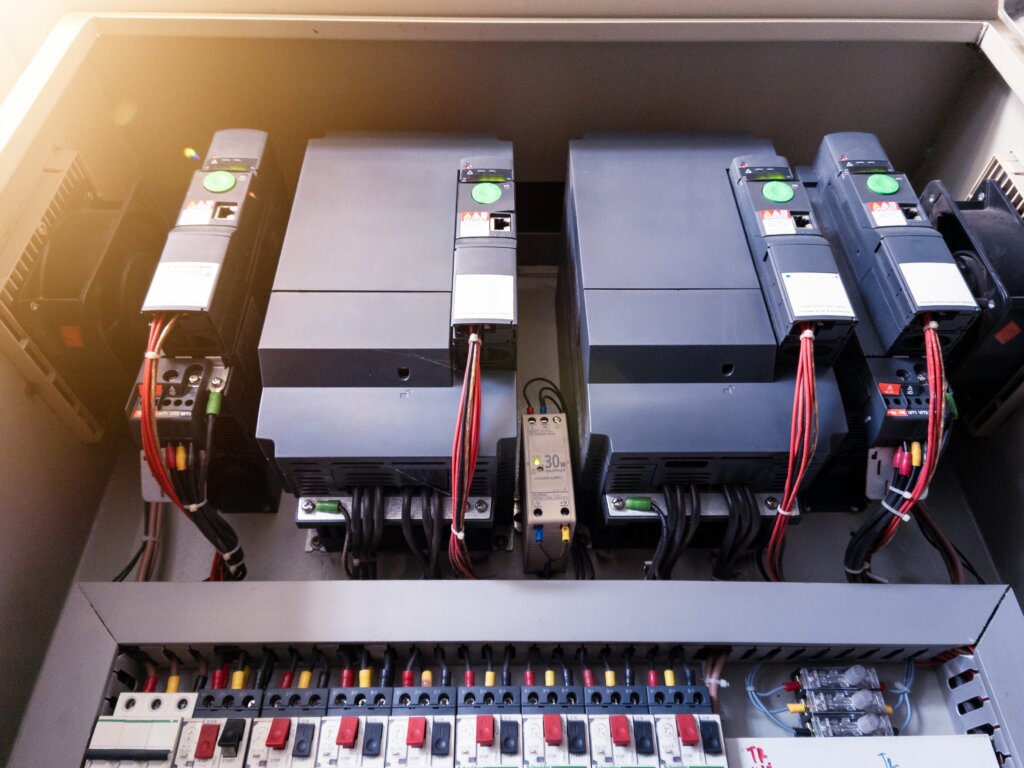
Common non-linear loads such as these variable frequency drives, generate harmonic currents that change transformer performance assumptions. While the VFDs are controlling the speed of electric motors by varying the frequency and voltage supplied to the motors, they are also introducing damaging harmonics into the electrical distribution network.
Transformer Specification Checklist For Harmonic Loads
Effective harmonic mitigation and electrical isolation begin with precise, data-driven transformer specifications. The following technical considerations are essential for ensuring reliable performance in harmonic-rich environments.
Load Profile and Harmonic Content
A thorough understanding of the magnitude and type of nonlinear loads is essential for effective transformer specification, as factors like THD, current spectrum, and duty cycle directly influence design decisions. Engineers must quantify both current and voltage THD for typical and worst-case scenarios, identify the predominant harmonic orders present (such as the 3rd, 5th, or 7th), and also assess the duration and variability of nonlinear load operation. This comprehensive load profile analysis ensures that transformers are selected or designed to handle real-world harmonic conditions, minimizing the need for excessive derating and reducing the risk of premature failure or operational issues. Additionally, for projects requiring harmonics compliance, specifications should align with IEEE 519 and apply transformer capability evaluation approaches consistent with ANSI/IEEE C57.110.
K-rated (K-factor) Transformers vs. Harmonic Mitigating Transformers (HMTs)
A K-rated transformer is designed to tolerate harmonic heating, while a harmonic mitigating transformer is designed to reduce certain harmonic currents and their impact on the electrical system. K-rated transformers are designed to handle the additional heating effects of harmonics, with K-factor ratings (e.g., K-4, K-13, K-20), indicating their suitability for specific harmonic environments. However, K-rating is not a universal solution:
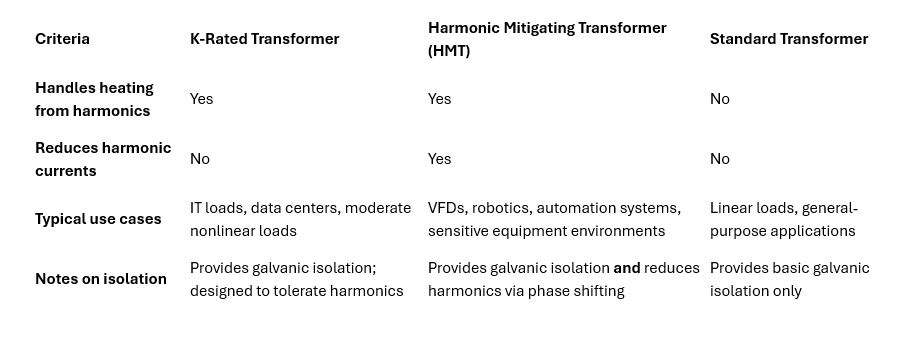
However, K-rating is not a universal solution:
- K-Factor Limitations:
K-rated transformers address heating but do not mitigate harmonics or provide electrical isolation.
- Harmonic Mitigating Transformers:
Purpose-built HMTs use advanced winding configurations (e.g., zig-zag, delta-wye) and flux management to cancel or block specific harmonics, reducing their propagation and impact.
Engineers must determine whether a K-factor rating is sufficient or if a custom HMT is required based on the harmonic profile and system criticality. While K-rated transformers are designed to handle the additional heating effects of harmonics, custom HMTs offer advanced winding configurations and flux management to actively reduce or block specific harmonics … thus providing enhanced protection for sensitive or mission-critical systems.
Transformer Derating For Harmonics (Temperature Rise, Cooling, Insulation Class)
Harmonics elevate transformer losses and operating temperatures, making it critical to specify thermal characteristics that match real-world conditions. Selecting the appropriate insulation class (e.g., Class 220°C) ensures the transformer can withstand elevated temperatures without compromising lifespan. Defining an acceptable temperature rise (typically 80°C or 115°C) helps align transformer performance with both the anticipated load and ambient environment.
Additionally, engineers should consider enhanced cooling strategies such as forced-air systems for applications with high harmonic content or sustained heavy loads. If harmonic levels exceed the transformer’s design limits, applying proper derating factors is essential to prevent overheating and premature failure. By specifying transformers for their actual thermal environment, engineers can ensure reliable operation, reduce maintenance needs, and minimize the risk of unplanned outages.
When To Use An Isolation Transformer For VFDs And Sensitive Loads
Isolation transformers provide galvanic separation between primary and secondary windings, which is critical for:
- Reducing Common-Mode Noise:
Proper isolation limits the transfer of high-frequency noise and harmonics, protecting sensitive equipment.
- Limiting Harmonic Propagation:
Advanced winding configurations can block or attenuate specific harmonic orders.
- Enhancing Safety:
Isolation transformers help meet code requirements for critical or sensitive loads.
Engineers should define isolation requirements based on system topology, equipment sensitivity, and regulatory standards. Careful consideration of these factors ensures that the transformer provides adequate protection against common-mode noise, limits the propagation of harmonics, and meets all safety and compliance obligations for the specific application.
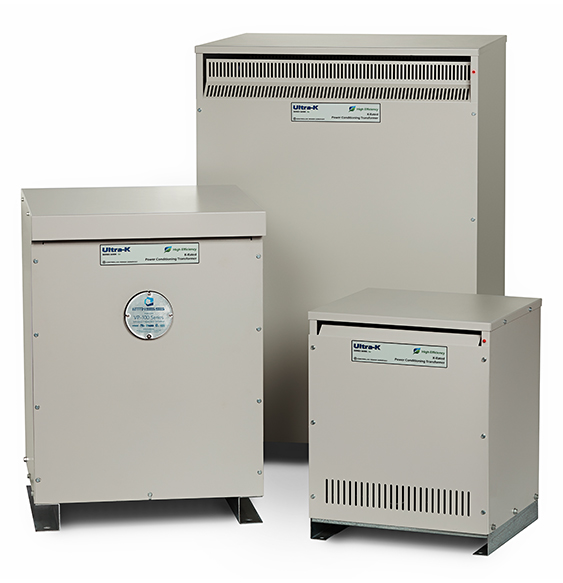
Trystar’s “Ultra-K Series 600K-he” K-rated power conditioning isolation transformers.
Triplen Harmonics And Neutral Overheating
Triplen harmonics (e.g., 3rd, 9th, 15th, etc) are zero-sequence currents that accumulate in the neutral conductor, especially in systems with substantial nonlinear loads. To prevent overheating and maintain system integrity, the neutral conductor must be adequately sized to handle these cumulative harmonic currents. Additionally, selecting appropriate winding configurations, such as delta-wye or zig-zag, can effectively trap or cancel triplen harmonics … thereby reducing neutral current and improving phase balance. By carefully specifying both neutral sizing and transformer winding configuration, engineers can minimize the risk of overheating, reduce system imbalance, and ensure long-term reliability.
Precise, data-driven transformer specifications tailored to actual harmonic conditions and system requirements are essential for achieving reliable, efficient, and resilient power system performance.
Why Early Specification Matters
Addressing harmonic performance early in the design process empowers engineers to control system reliability, efficiency, and lifecycle costs. When transformer specification is deferred or based on assumptions, mitigation often shifts to reactive measures such as installing filters, oversizing equipment, or implementing costly retrofits. However these corrective measures only add complexity, increase capital and operational expenses, and may not fully resolve underlying issues.
Transformers engineered for harmonic environments do more than survive … they stabilize power systems, protect connected equipment, and preserve operational margins as facilities evolve and expand. Early, data-driven specification is the foundation of resilient, future-ready electrical infrastructure.
By prioritizing harmonic considerations from the outset, engineers can design power systems that are both adaptable and robust, minimizing the risk of unexpected failures as facility demands change over time. This proactive approach not only streamlines project execution, but also supports long-term operational goals by reducing maintenance requirements and extending equipment lifespan. Early and precise transformer specification lays the groundwork for scalable, high-performance electrical systems that can confidently meet the challenges of tomorrow’s evolving load profiles.
Addressing harmonics in transformer specification from the very beginning is crucial for building reliable, efficient, and future-ready power systems that avoid costly, reactive fixes down the line.
A Trusted Partner in Transformer Specification
Specifying transformers for harmonic mitigation and isolation is not simply a matter of selecting a catalog item … it is an engineering challenge that requires a holistic understanding of the entire power system. Trystar partners with engineers from the earliest stages of design, providing deep expertise in power distribution, harmonic analysis, and custom transformer solutions.
By engaging Trystar early, engineers gain access to:
- Comprehensive Harmonic Analysis:
Data-driven insights into load profiles and harmonic content.
- Custom-Engineered Solutions:
Transformers tailored to specific harmonic isolation and thermal requirements.
- Lifecycle Support:
Guidance from initial specification through installation, commissioning, ongoing operation, and preventive maintenance visits.
Trystar’s collaborative approach ensures transformers are specified correctly the first time … thus delivering clarity, confidence, and performance in even the most demanding harmonic environments.
Need help specifying a transformer for harmonics or evaluating K-rated vs HMT options? Connect with Trystar today, and experience the difference that expert partnership makes in transformer specification and system reliability.