Our team is here to support you and solve your power challenges. Connect with our responsive experts today to learn about our customized power solutions and products.
ULTRA-K Series 600K-he (5 kVA - 25 kVA ) Single Phase
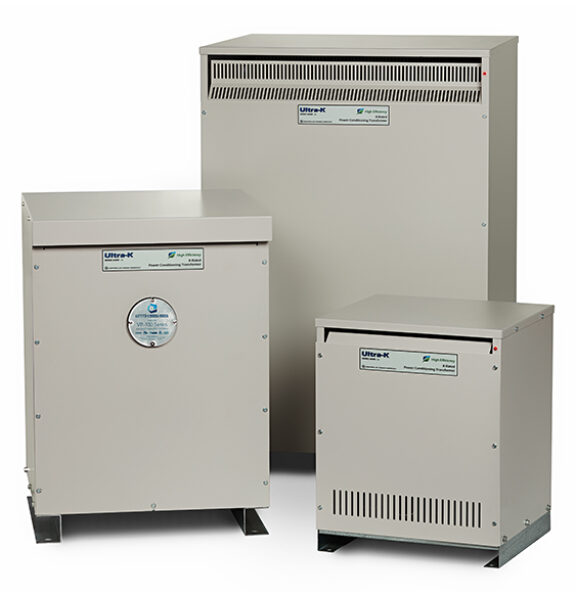
The Trystar ULTRA-K Series 600K-he is a high-efficiency, K-rated power conditioning transformer engineered to protect sensitive electronic loads while lowering operating costs. Designed to exceed DOE 2016 minimum efficiency standards, it delivers superior electrical noise attenuation and transient voltage suppression, ensuring clean, reliable power for mission-critical systems. With multiple K-factor ratings (K4, K7, K13, K20), the ULTRA-K safely handles harmonic currents from non-linear loads, extending the life of LED drivers, ballasts, and electronic equipment. Durable copper-wound construction, optional surge protection, and versatile enclosure choices make it a long-lasting, adaptable solution for industrial and commercial applications.



Features
- High Efficiency, Lower Costs – Exceeds DOE 2016 efficiency standards, reducing energy losses and lowering lifetime operating expenses.
- Protects Sensitive Equipment – Delivers superior noise attenuation and transient voltage suppression, shielding electronics from harmful spikes and surges.
- Handles Non-Linear Loads – Available in K4, K7, K13, and K20 ratings to safely manage harmonic currents and prevent overheating in today’s electronic-rich environments.
- Extends Equipment Life – Clean, regulated power reduces stress on LED drivers, ballasts, and sensitive electronics, extending service life.
- Durable Copper-Wound Construction – All-copper windings optimize conductor size and geometry, enhancing efficiency and long-term reliability.
- Flexible Installation Options – Standard NEMA 2 enclosure with optional NEMA 3R outdoor version, plus available input/output breakers and lug kits for installer convenience.
- Enhanced Safety & Monitoring – Optional features include surge protection devices (SPD), temperature alarms, and infrared scanning windows, supporting safe, proactive maintenance.
- Customizable for Your Needs – Offered with multiple input/output voltage options, shielding levels, and accessories to fit a wide range of commercial and industrial applications. Also has versatile enclosure options such as standard NEMA 2 for indoor use and NEMA 3R for outdoor environments, ensuring safe installation anywhere it’s needed.
Specifications
- Efficiency: Meets and exceeds DOE 2016 minimum efficiency standards (U.S. DOE 10 CFR Part 431). Meets and exceeds CSA Standard C802.2-12 (Canada).
- Voltage Compensation Taps: Full capacity above and below nominal with multiple field-selectable taps.
- Output Impedance: 2% – 3.5% typical.
- Output Distortion: Less than 1.0% THD added under linear load.
- Load Regulation: 2% typical, no load to full load.
- Overload Capacity: Up to 500% for 10 seconds, 1000% for 1 cycle.
- Isolated Neutral: Establishes a new neutral-to-ground bond on the transformer’s output for safer operation.
- Common Mode Noise Attenuation: 126 dB (standard double shielding); 146 dB (optional triple shielding).
- Transverse Mode Noise Attenuation: 3 dB down at 10 kHz, decaying 20 dB per decade; decaying 40 dB with optional SPD & filter.
- Operating Temperature: -25°C to +40°C
- Audible Noise: 45 – 50 dBA at 1 meter (size dependent).
- Temperature Rise: 135°C rise above ambient under non-linear loading, per UL 1561 standard.
- Certifications: UL 1561 Listed and labeled for operation at or below specified K-factor rating. C-UL Listed to CSA C22.2 No. 47-13.
- Single Phase Sizes: 5 kVA, 8 kVA, 10 kVA, 15 kVA, 20 kVA, 25 kVA
Documentation
Instruction / Owners Manuals
Product Brochures
Support

Services
Technical Support, Start Up Support, Preventative Maintenance, Field Service, In-house Repair, Spare Parts
Website: https://www.trystar.com/services/request-for-services/
Phone: 507-333-3990,1
Email: services@trystar.com

Sales Support
Quotes, lead times, and general product questions
Website: https://www.trystar.com/contact/
Phone: 507-333-3990,2
FAQs
Does the ULTRA-K exceed the DOE 2016 minimum efficiency standard?
Yes! Efficiency for a given kVA size will vary from transformer to transformer, but the ULTRA-K’s design allows its efficiency to still exceed the minimum DOE-mandated level.
How is electrical noise generated?
While conditions external to a facility can cause electrical noise and impulses, the majority of these disturbances are generated by electronic and electrical equipment within the facility. Examples of this equipment include photocopiers, lighting controls, variable speed drives, and motor loads.
Will a Surge Protection Device alone attenuate electrical noise?
No, not necessarily. A typical SPD is designed to protect against high-energy voltage transients, not electrical noise.
Why add a Surge Protection Device to the output of the ULTRA-K?
An SPD is designed to protect against high energy voltage transients by clamping them at a safe voltage level. It will ensure that dangerous high energy (and high voltage) transients never reach critical downstream equipment. The SPD is a perfect complement to the ULTRA-K transformer. Together, your critical equipment will be protected from both disruptive electrical noise and damaging high energy transients!
What is a K-rated transformer?
A K-rated transformer is one which is used to accommodate harmonic generating loads. Harmonics generate additional heat in the transformer and cause non-K-rated transformers to overheat, possibly causing a fire. K-rated transformers are sized appropriately to handle this additional heat, and are tested to UL 1561 rigorous standards.
Where would I use a K-rated transformer?
Anywhere non-linear loads are present. New construction, renovations, factory automation, computer rooms, and office buildings are prime locations for K-rated transformers because of the type of equipment being used which generates harmonics.
What is electrical noise, and what problem does it cause?
Electrical noise is a high frequency, low energy signal that travels on the power and ground lines of an electrical distribution system. This electrical noise can harm digital circuitry because the high frequencies can easily be coupled into the signal path and cause data corruption. This corruption often results in system upset, unexpected restarts, and nuisance equipment behavior.
How does the ULTRA-K attenuate electrical noise?
Noise attenuation is a function of the transformer itself and its ability to attenuate common mode noise (noise between the line and ground conductors) and transverse mode noise (noise between the line conductors). To address common mode noise, the ULTRA-K is manufactured using full-length electrostatic shields to minimize the capacitance between the primary and secondary of the transformer.rnrnProviding two shields greatly reduces this capacitance. Adding a third shield reduces the capacitance even more. By reducing this capacitive value, the electrical noise attenuation increases! The design and application of these shields are critical to the noise attenuation achieved. As for transverse mode noise, it is primarily the inductance of the transformer that determines the attenuation level, which is frequency-dependent.
What is a K-factor?
It is a value used to determine how much harmonic current a transformer can handle without exceeding its maximum temperature rise level. K-factor values range from 1 to 50. K-factor of 1 is used for linear loads only, and a K-factor of 50 is used for the harshest harmonic environment possible. A K-factor of 7 to 13 is typical. When transformers use a K-factor value, they are said to be K-rated.
How does a K-rated transformer handle the heat generated by harmonics?
To handle increased internal temperatures, either the geometry of the coil conductor is changed or multiple conductors are used to minimize the heating effect caused by load-generated harmonics. Quality transformers are also manufactured with a high grade silicon steel, copper windings, and more air ducts.
How much K-rating do I need?
Typically a K-13 rated transformer is sufficient for most applications. Loads approaching 100% non-linear or more than 75% THD should incorporate a K-20 rated transformer.
Why are copper-wound transformers better than aluminum?
Copper has a higher current carrying capacity than aluminum, which is an important factor when designing K-rated transformers for harmonic-rich loads. Copper allows you to minimize the conductor used and optimize its geometry by using flat, rectangular wire to increase the surface area of the conductor. This reduces stray losses within the transformer, thus the heating effect from harmonics. Less power losses lead to higher efficiency.
Designed for Real-World Demands
Discover how this product is used across markets for different applications.

Commercial
Discover a range of electrical solutions to keep commercial buildings operational and secure. Benefit from our engineering expertise and manufacturing agility, allowing for customized solutions to meet your specific needs.

Education
Meet emergency power requirements and safeguard your community with trustworthy power solutions that supply a swift connection.

Entertainment / Events
From concerts to festivals, our versatile power solutions will keep every piece of your equipment seamlessly running for the duration of the event.

Industrial
Enhance productivity, efficiency, and safety in various industrial applicationswith Trystar’s innovative, customer-centric solutions gained through our experience helping our customers solve their power challenges.